

Attractions
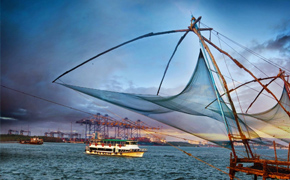
Kochi (also known as Cochin) is a city in southwest India's coastal Kerala state. It has been a port since 1341,
when a flood carved out its harbor and opened it to Arab, Chinese and European merchants. Sites reflecting those influences
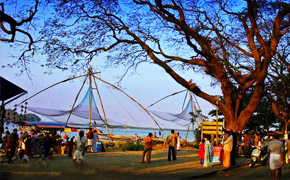
include Fort Kochi, a settlement with tiled colonial bungalows and diverse houses of worship. Cantilevered Chinese fishing nets,
typical of Kochi, have been in use for centuries. Called the Queen of the Arabian Sea, Kochi was an important spice trading
centre on the west coast of India from the 14th century onward, and maintained a trade network with Arab merchants from the
pre-Islamic era. Occupied by the Portuguese in 1503, Kochi was the first of the European colonies in colonial India.
It remained the main seat of Portuguese India until 1530, when Goa was chosen instead. The city was later occupied
by the Dutch and the British, with the Kingdom of Cochin becoming a princely state. Kochi ranks first in the total
number of international and domestic tourist arrivals in Kerala.
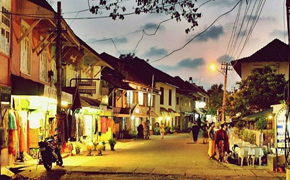
Jew Street will always tickle that nostalgic bone in you. As you stroll through these streets,
there is always something that triggers a mellifluous trip down memory lane. You can choose from curios, antique pieces of crockery,
carved wooden furniture, bronze and brass sculptures, remnants of traditional houses, and jewellery. The antique sellers love having
a chat and keeping you informed about the origins of the items and their own shops. Their lives are colourful reminders of a once
strong community whose numbers have dwindled considerably over the years. With its famous Paradesi Synagogue and Jew Street,
Kochi is the best place in the State to experience the lifestyle and culture of the Jewish community in the sub-continent.
Jew Street will always tickle that nostalgic bone in you. As you stroll through these streets,
there is always something that triggers a mellifluous trip down memory lane. You can choose from curios, antique pieces of crockery,
carved wooden furniture, bronze and brass sculptures, remnants of traditional houses, and jewellery. The antique sellers love having
a chat and keeping you informed about the origins of the items and their own shops. Their lives are colourful reminders of a once
strong community whose numbers have dwindled considerably over the years. With its famous Paradesi Synagogue and Jew Street,
Kochi is the best place in the State to experience the lifestyle and culture of the Jewish community in the sub-continent.
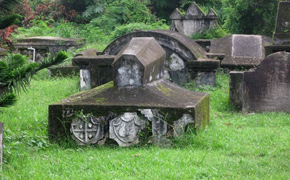
The Dutch connection of Fort Kochi does not end with the above mentioned two churches.
Down the road from St Francis Church, that runs parallel to the beach, stands the Dutch Cemetery. The cemetery,
which was consecrated in 1724, is believed to be the oldest in the country.
The cemetery, built in the style of the Dutch architecture of the time, is surrounded by walls and the year 1724 is engraved on the entrance pillar. The epitaphs and tombs, numbering 104, carry the authentic records of hundreds of people of Dutch and British nationality
The cemetery, built in the style of the Dutch architecture of the time, is surrounded by walls and the year 1724 is engraved on the entrance pillar. The epitaphs and tombs, numbering 104, carry the authentic records of hundreds of people of Dutch and British nationality
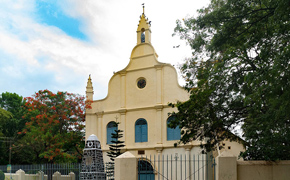
The St. Francis Church, well-known for its beautiful structural design and ambience, has an
important place in history. It is here that the famous explorer, Vasco-da-Gama, was originally buried. His remains would be
taken back 14 years later but to this day, the exact spot is clearly marked. The place is known for its deep Dutch and
Portuguese influences and is an architectural marvel in itself.
The credit for its construction goes to the Portuguese Franciscan Friars in 1503. Originally made with mud and wood, it went under a lot of work with the Portuguese, Dutch and the British leaving their imprints on the place. Eventually it would come under the control of the Church of South India in 1949. Visitors are especially charmed by its gabled timber framed roof.
The credit for its construction goes to the Portuguese Franciscan Friars in 1503. Originally made with mud and wood, it went under a lot of work with the Portuguese, Dutch and the British leaving their imprints on the place. Eventually it would come under the control of the Church of South India in 1949. Visitors are especially charmed by its gabled timber framed roof.
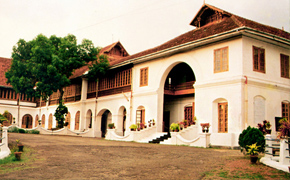
Located at Tripunithura, The Hill Palace is the largest archaeological museum in Kerala.
It was built in the year 1865 and was once the Imperial Administrative offices and official residence of the Maharaja of Cochin.
Just as the name suggests, the massive palace is located on a hill and has a beautiful garden. Built in 1865, the Palace complex
consists of 49 buildings in the traditional architectural style, spreading across in 54 acres. The complex has an archaeological
museum, a heritage museum, a deer park, a pre-historic park and a children's park. The huge white coloured buildings are neat,
clean and well maintained. The terraced lawn, ponds and fountain are perfect for outdoor photography. The palace is also famous
for being the backdrop of various movies.
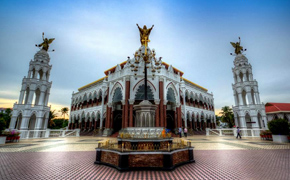
St.George's Forane Church has a glorious history of 14 centuries. Fourteen centuries ago,
there was no nation called India. Nor a state called Kerala. And no city called Cochin. Much of what is called the city of Cochin today
simply did not exist and the waters of the Arabian Sea reached all the way up to the shore of Edappally. Edappally was then a small
hamlet, a part of the princely kingdom of Elangalloor. The people of Edappally lived a simple life, the comforts of life being
non-existent at that time. The Catholic congregation at Edappally was rather small and they were all descendants of the Hindus
converted into Christianity by St.Thomas the Apostle (alias Dideemos) who came to India to preach the Gospel.
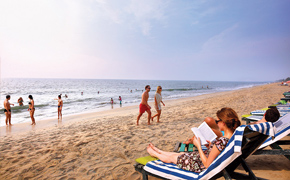
Around two dozen kilometres from the industrial district of Ernakulam and to the side of the Vypeen
Island lies every swimmer’s paradise, Cherai Beach. It is a favourite haunt of those looking for a relaxing swim with the backdrop
of coconut groves being the added incentive. It provides a wonderful view of the famous Chinese Fishing Nets or Cheena Vala well.
The nearby shacks provide you with fresh cuisine that fills you up perfectly after a delightful swim.
The seashells found here are unique and one often runs into dolphins in this area. It is the ideal blend of both the backwaters and the sea. The area itself has seen many new resorts and hotels crop up, which have facilitated the increase in tourist activity.
The seashells found here are unique and one often runs into dolphins in this area. It is the ideal blend of both the backwaters and the sea. The area itself has seen many new resorts and hotels crop up, which have facilitated the increase in tourist activity.
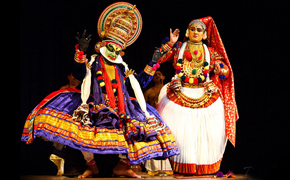
‘Kathakali’, an important genre in the Indian classical dance form, is associated with storytelling form
of this art. It is the dance drama from the south Indian state of Kerala. Similar to other Indian classical dance arts, the story in ‘Kathakali’
is also communicated to audience through excellent footwork and impressive gestures of face and hands complimented with music and vocal performance.
However it can be distinguished from the others through the intricate and vivid make-up, unique face masks and costumes worn by dancers as also
from their style and movements that reflect the age-old martial arts and athletic conventions prevalent in Kerala and surrounding regions.
Traditionally performed by male dancers, it developed in courts and theatres of Hindu regions contrary to other Indian classical dances
which predominantly developed in Hindu temples and monastic schools.
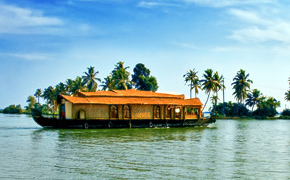
Referred to as the Venice of the East, Alappuzha has always enjoyed an important place in the maritime
history of Kerala. Today, it is famous for its boat races, backwater holidays, beaches, marine products and coir industry. Alappuzha
Beach is a popular picnic spot. The pier, which extends out to the sea here, is over 137 years old. Entertainment facilities at the
Vijaya Beach Park add to the attraction of the beach. There is also an old lighthouse nearby which greatly intrigues all visitors.
Another delightful experience while in Alappuzha is the houseboat cruise. The houseboats you find in the backwaters of Alappuzha
are in fact a reworked version of the Kettuvallams of olden times. Kettuvallam is a Malayalam word, ‘Kettu’, refers to dwelling
structures and ‘Vallom’ means boat. In the olden days, kettuvallam or boat with thatched roof that covers over wooden hulls was
used to carry tons of rice and spices.
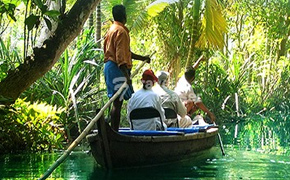
The scenic backwaters of Kerala comprise serene stretches of lakes, canals and lagoons located parallel
to the coast of the Arabian Sea. The backwater regions of Kerala are one of the most popular tourist destinations in the world.
The tranquil backwater cruises are a once in a lifetime experience. Alappuzha, known as the 'Venice of the East', is especially
popular for its houseboat cruises where you can soak in nature at its finest form.
Of late, houseboats come equipped with all the comforts of a good hotel room including furnished bedrooms, modern toilets,
cozy living rooms, a kitchen and even a balcony for angling. An uninterrupted view of life in the backwaters can be enjoyed
while staying in a houseboat.
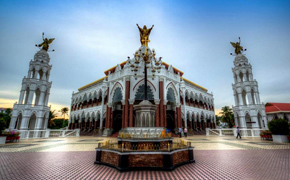
Munnar - breathtakingly beautiful - a haven of peace and tranquility - the idyllic tourist destination
in God's own country.
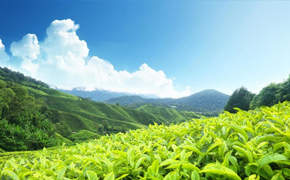
Set at an altitude of 6000 ft in Idukki district, Munnar was the favored summer resort of the erstwhile British rulers in the
colonial days. Unending expanse of tea plantations pristine valleys and mountains exotic species of flora and fauna in its
wild sanctuaries and forests aroma of spice scented cool air yes! This beautiful destination has all these and more.
It's the place you would love to visit it's the place you would wish never to leave. Munnar is such a beautiful place in Kerala,
which cannot be portrayed in a single canvas. Everything and anything here will make us excited. The hills, the mist, the valleys,
the streams, the waterfalls, tea plantations, rare flora and fauna....
Idukki is Kerala's second largest district and has been blessed with numerous natural wonders.
The high valleys and hill ranges of this landlocked region are fed by three major rivers - Periyar, Thalayar and Thodupuzhayar
and their tributaries. Its forest still hosts many tribes and over half of the terrain is still covered with forests.
People love going to the gigantic arch dam for getting its mesmerising view. Blessed with a wide range of trekking trail,
each of them offers a spectacular view of the valley below and ranges above of Idukki. The place is also renowned for its
exotic flora and fauna and one can come across many rare species while visiting Idukki. Idukki's speciality lies in its arch dam
which is the largest in the country, and the Anamudi, which is the highest peak in India, south of the Himalayas. Idukki is situated
at the top of the Western Ghats surrounded by mountains. The arch dam built across the Kuravan Kurathi mountain is incredible and
beyond description.